Cups, spoons and a scale: choosing measuring tools
Choose tools that match the recipes you use and the quantities you regularly measure.
Notice the units first
Before buying a measuring set, look at several recipes you return to. Do they use grams, millilitres, cups or spoons? A scale and a jug solve different problems, and a cup set is useful only when its capacity corresponds to the recipe convention. Do not assume every cup mentioned online is the same volume.
Check the printed capacity of each tool. A household drinking cup is not a substitute for a specified measuring cup simply because it has a similar name. If you use recipes from several places, keep their unit conventions visible rather than relying on a single unmarked vessel.
Choose legible markings
A measuring jug should be readable from the position in which it is used. Fine pale markings can disappear against some ingredients, and embossed numbers may be difficult to see in low light. Examine both the largest and smallest divisions. A large jug is often clumsy for a small quantity.
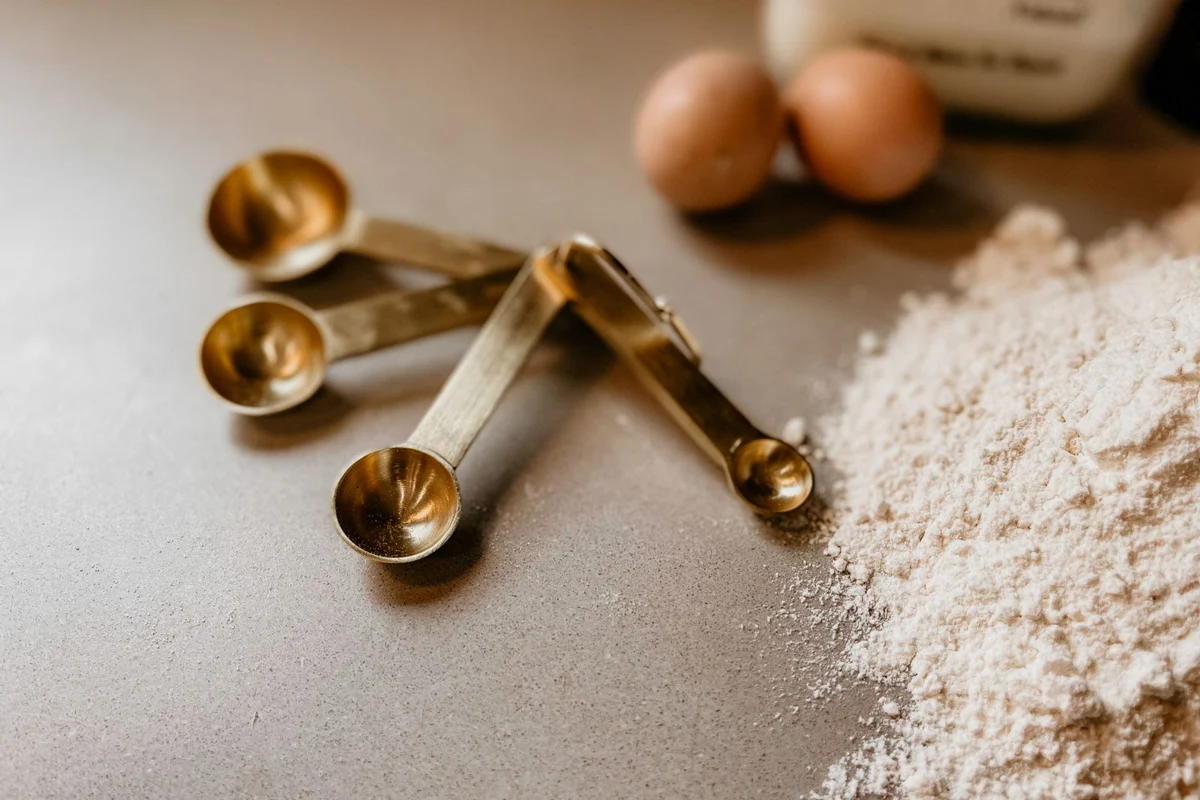
For cups and spoons, consider whether the number is moulded, engraved or printed where repeated washing will affect it. The handle should be comfortable without making the tool too long for the drawer. A ring keeps a set together, but it may also mean washing several pieces after using only one; a removable ring offers a choice.
Flat rims can help with levelling dry ingredients where a recipe calls for that method. Deep narrow spoons may not fit into spice jars. Check the jar openings you actually use before buying a set with attractive but bulky bowls.
A scale needs a place to stand
A kitchen scale should sit on the stable surface specified in its instructions. Compare maximum capacity, displayed increments and the size of the platform. A large bowl must not hide the display or press against another object. Check whether the unit can be changed clearly and whether the tare function is easy to understand.
Displayed increments are not the same as a guarantee of accuracy at every small quantity. Follow the maker's specifications for the intended range. If measuring tiny amounts is important, establish that the scale is suitable rather than assuming a kitchen model will cover every task.
Think about cleaning and storage. A slim scale can slide into a cupboard, but it should not be stored in a way that damages its platform or controls. Keep it away from spills beyond its stated protection and do not immerse an electronic device unless its manufacturer explicitly permits that treatment.
Make one recipe repeatable
Choose a familiar recipe and look at where your current measurements vary. Perhaps flour is scooped with a different mug each time, or a small liquid quantity is judged in a large jug. Buying a precise-looking set will not resolve that unless the method changes with it. Follow the recipe's stated approach, including whether a spoon is level or a quantity is weighed, and record the unit clearly.
A scale can reduce the number of vessels used when ingredients are added to one bowl, but the display must remain visible and the capacity must cover the bowl plus contents. Check the instructions for taring and automatic shut-off. If you pause for a long time between additions, an unexpected shut-off may complicate the sequence; plan the task around the actual device rather than assuming all scales behave alike.
For shared cooking, store the measuring tools together and identify any unusual capacity. Someone reaching for a spoon should not have to guess which unmarked utensil was used last time. Consistency comes from a clear recipe and an understandable tool, not from collecting the largest set of sizes.
Build the set slowly
For many routines, a readable jug, a few useful spoons and a suitable scale cover more work than several decorative sets. Start with the units in your recipes and add a tool only when repeated improvisation is getting in the way.
Label conversions in the recipe note if needed, using a reliable source and keeping volume and mass distinct. A cup of one ingredient does not weigh the same as a cup of another. The aim of measuring tools is repeatability, so the method and unit deserve as much attention as the object.