Turn product dimensions into a real footprint
A few marks on the floor can reveal what a product photograph leaves out.
Give each number a direction
A listing that says 40 by 30 by 60 centimetres is incomplete until you know which number is height, width and depth. Look for a labelled diagram. Do not infer the order from another product on the same website; sellers can arrange dimensions differently.
Distinguish the assembled item from its package. A flat-packed shelf may arrive in a long narrow carton, while the finished object has a much larger footprint. For a container, external dimensions answer whether it fits a cupboard; internal dimensions answer whether it holds your things. You may need both.
Mark the space at home
Use removable paper or another method that will not damage the surface to outline the object's footprint. Walk past it. Open the nearby door. Pull out a chair. The empty rectangle makes a surprisingly good test of whether the purchase will interfere with daily movement.
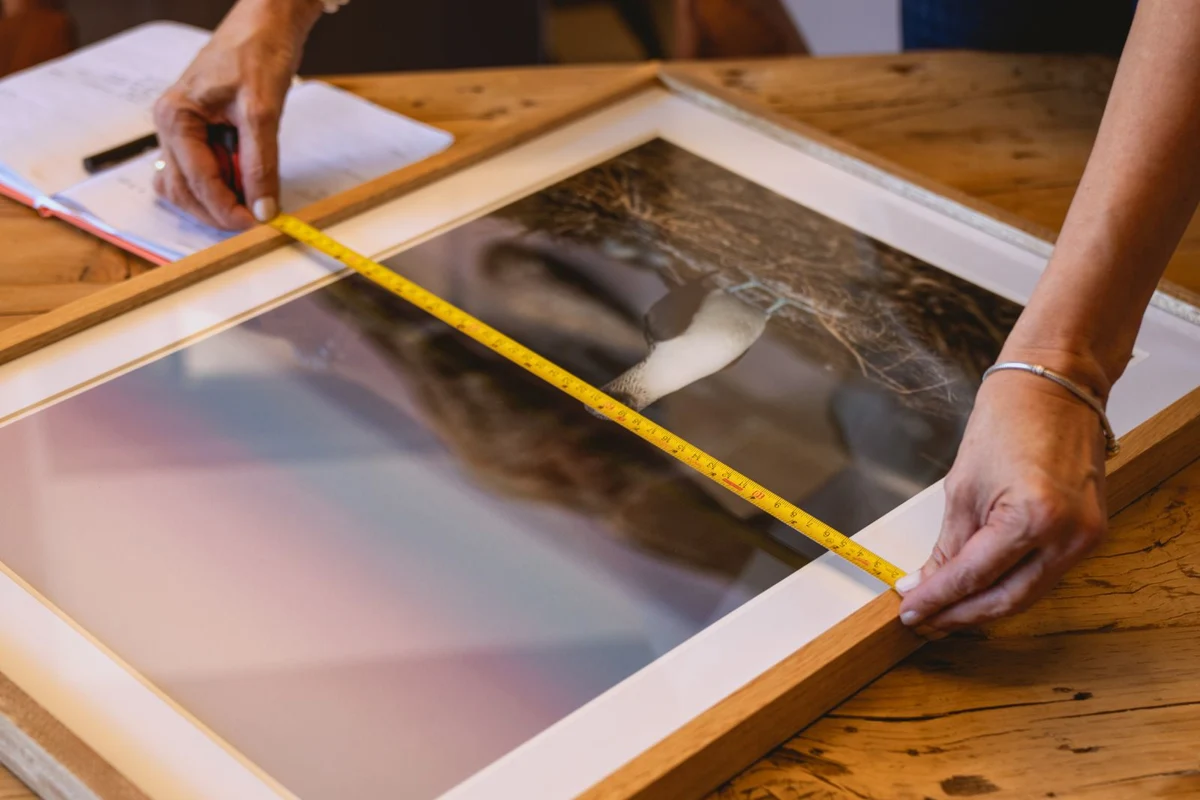
For a tall item, hold a tape measure vertically or mark the height on a temporary sheet of paper. Check switches, wall shelves and windows above it. A cabinet can fit on the floor while preventing a window from opening. Allow for skirting boards that stop the back from sitting flush against the wall.
Measure the narrowest point, not just the easiest point. Cupboard hinges, shelf supports and door frames can reduce usable space. A basket that fits between the side panels may still catch on the hinges when you try to pull it out.
Add the movement
A drawer needs room to open and a lidded box needs clearance above. Handles can project beyond the stated body dimensions. Find out whether those projections are included in the measurement, especially when the fit is close.
For an appliance, use the installation instructions to establish ventilation and service clearances. Do not treat a close physical fit as permission to squeeze it into a niche. If the instructions are unavailable before purchase, ask the manufacturer rather than guessing an allowance.
Also consider the person using the object. A storage bin on a high shelf may be difficult to lift safely when full, even if its dimensions are ideal. Place frequently used items where they can be reached without moving several other things.
A worked comparison
Suppose a shelf opening is 45 centimetres wide and a basket is listed as 44 centimetres. That leaves only one centimetre in total, before allowing for a bulging fabric side, handles or an imperfectly square opening. The dimensions suggest a possibility, not a comfortable fit. A slightly smaller basket may be easier to use every day.
Write the usable measurements in a note beside the product link. Include a photograph of the space if it helps you remember an obstruction. When comparing alternatives, you can then judge them against the same real constraints instead of repeatedly imagining a room that is larger than yours.
If a crucial measurement is missing, leave the purchase undecided. A precise question to the seller is more useful than a hopeful assumption, particularly for objects that will be expensive or awkward to return.
When measurements disagree
A product title, diagram and specification table can occasionally give different figures. Check whether one refers to the package, another to the body and another to the largest projection. If the difference cannot be explained, ask the seller to identify the assembled dimensions of the selected variant in writing. Do not average the numbers and hope the result is close.
For handmade or flexible items, look for any stated dimensional tolerance. A fabric basket can change shape when filled, while an irregular woven rim may be wider at one point. When a fit is exact, choose a rigid item with clear measurements or leave enough clearance for the variation.
Remember that a home measurement has uncertainty too. An old alcove may not be square, and a shelf can narrow towards the back. Take more than one measurement where the object will sit. The smallest usable width and depth usually deserve attention, along with the space needed to get the item in and out.
For an online purchase, keep a simple sketch with the measurements marked on it. This prevents a later comparison from reversing width and depth. It also makes a question to the seller easier to understand: you can describe the opening and the obstruction instead of asking whether the product will fit a small cupboard.