Storing sarees without making a wardrobe heavier
Weight, embellishment and access matter more than making every folded saree the same size.
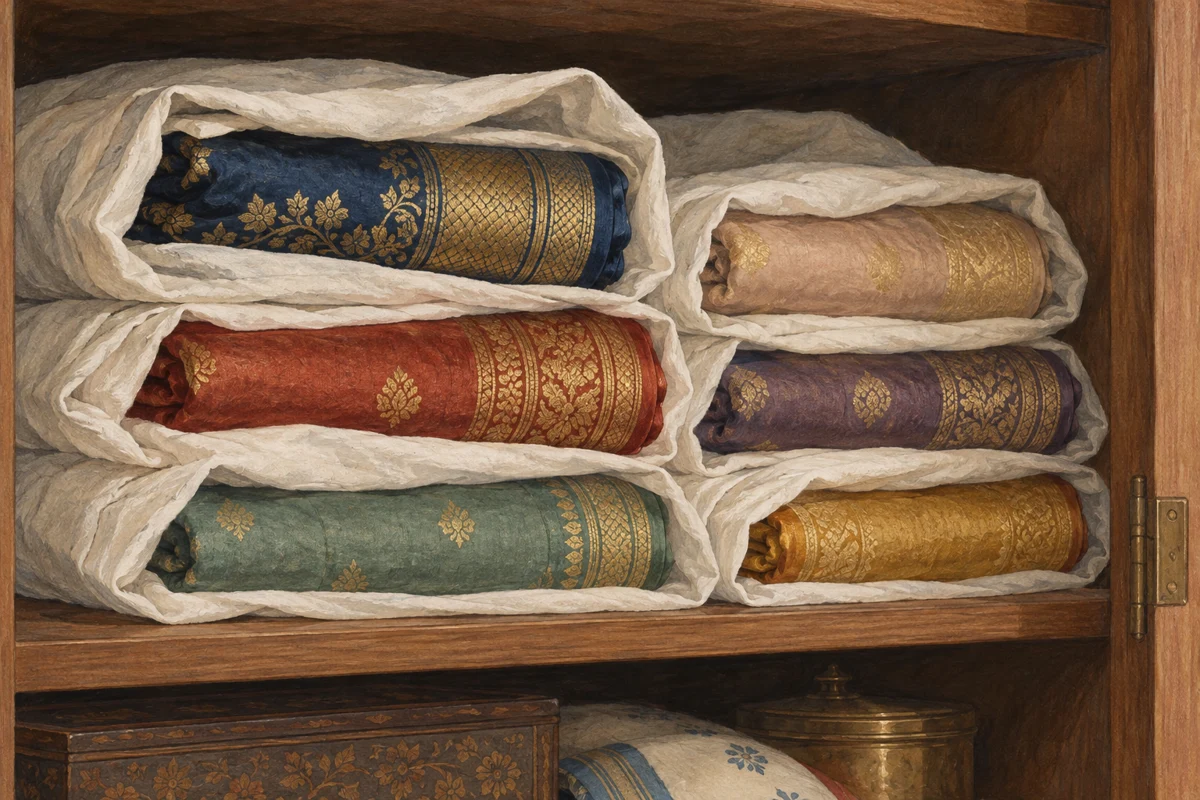
Separate the working wardrobe from special pieces
A frequently worn cotton saree and an embellished silk piece do not necessarily need the same storage. Begin by grouping according to use and care needs. Everyday items should be easy to reach; delicate or rarely worn pieces may need more support and protection from handling.
Read the garment's care information and keep any instructions supplied by the maker. If a valuable or fragile piece has no clear guidance, seek appropriate textile-care advice rather than trying a household storage trick. The same applies to older textiles whose condition is uncertain.
Avoid a heavy pile
A tall stack can make the lower sarees difficult to retrieve without pulling against fabric above them. Split the collection into smaller groups or use suitable shallow storage. The aim is to support the textile and reduce repeated dragging, not to achieve a perfectly uniform shelf edge.
Consider the weight of borders and decoration. A heavy embellished section can put pressure on folds or catch neighbouring cloth. Keep surfaces smooth and use suitable protective materials where recommended. Do not add newspaper or an unknown coloured lining that could transfer marks.
Give folds some space
Conservation guidance for textiles favours support and fewer, gentler folds where possible. Household storage has practical limits, but the principle is useful: avoid forcing a saree into a tiny rigid rectangle just to fit an organiser. Delicate folds may benefit from appropriate padding and periodic review, following advice suited to the textile.
Hanging is not automatically better. A heavy piece can strain at its support points, and clips can mark delicate areas. Use a hanging method only when suitable for the particular garment. A general multi-hanger should not decide the treatment of an irreplaceable piece.
Put it away ready for storage
Make sure the saree has been cared for appropriately and is fully dry before it is enclosed. Do not seal away a recently worn garment without considering moisture, soil or its cleaning instructions. Fragrance products and improvised pest treatments can introduce their own problems; use only methods suitable for the material and situation.
Keep storage away from obvious leaks, damp surfaces and strong light. A decorative clear box may expose a special piece unnecessarily. Check the cupboard periodically rather than assuming a closed cover guarantees protection.
Keep a small record for special pieces
For a saree worn only occasionally, a short record can prevent repeated handling. Note the material information supplied, any care advice and where the matching pieces are stored. A photograph of the border can be enough to distinguish two similar covers. This is particularly useful when several people help prepare clothing for an event.
Record a concern when you notice it rather than trying to remember later: a loose decorative element, a stain needing suitable attention or a cover that catches the fabric. Deal with it through an appropriate care route before the next occasion. Do not attempt a repair merely because it is hidden inside a fold during storage.
When the saree returns from use, compare its condition with that note and give it the required care before putting it back. The record need not become an inventory of every garment. Reserve it for pieces where clear identification and remembered instructions reduce unnecessary unfolding or last-minute decisions.
Make identification gentle
A small label or photograph on the cover can help you locate a saree without unfolding several others. Describe colour, border or occasion in a way that is meaningful to you. Avoid attaching labels directly to delicate cloth or decorative work.
Keep matching accessories together only when their materials will not snag or mark the fabric. A separate small compartment may be preferable for jewellery or sharp fastenings. A blouse can be identified alongside the saree without being pressed tightly into every fold.
Start by reorganising one shelf and use it for a few weeks. If a frequently worn piece keeps ending up on a chair, its storage may be too elaborate. If a special piece is compressed under everyday clothing, give it a more protected position. The wardrobe can have more than one method because the garments have more than one need.