When vacuum storage bags create extra work
Compression can save volume while making access, inspection and repacking less convenient.
Choose a suitable textile first
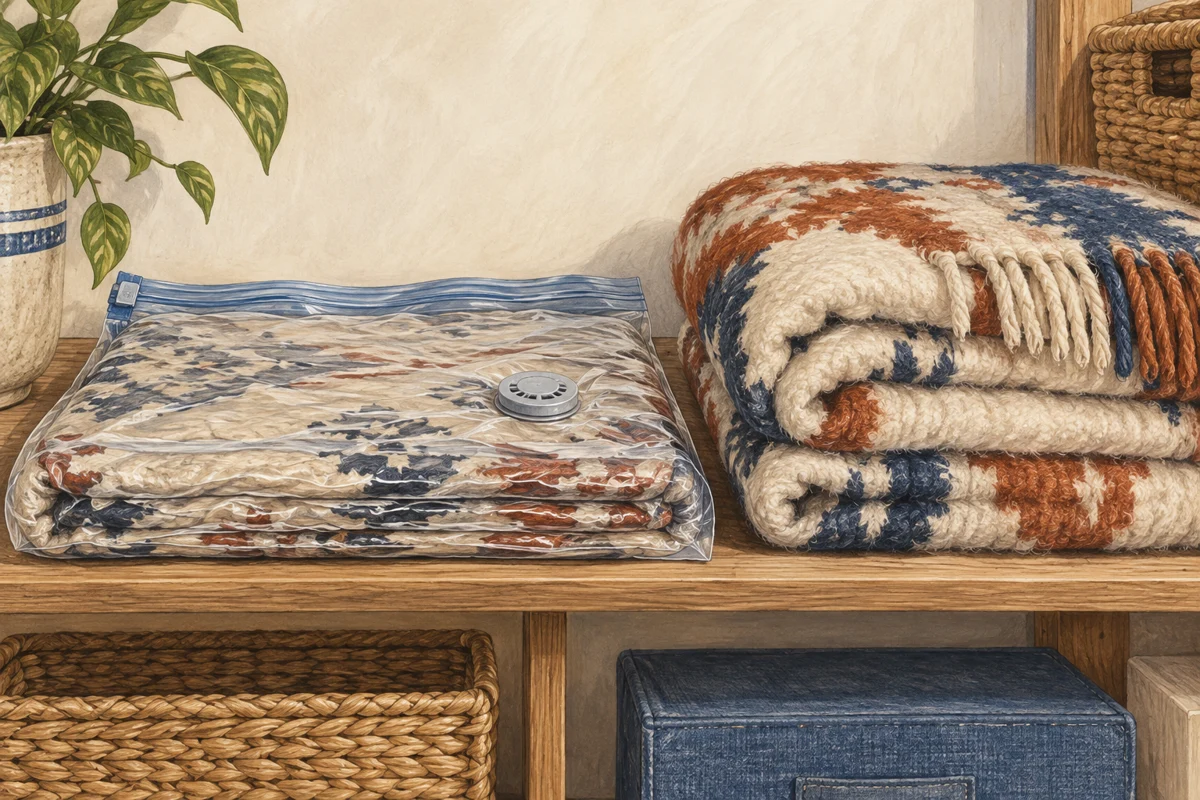
Vacuum storage bags remove air around their contents, but they are not suitable for every garment or household textile. Read both the bag instructions and the textile's care guidance. Delicate, structured or embellished items may need a different storage method, and some fillings should not be compressed.
Do not start with an irreplaceable saree or a favourite padded item simply because it takes the most space. If the maker advises against compression, use that instruction. A bag's large capacity does not make every soft object an appropriate filling.
Measure the packed shape, not the promise
A percentage reduction in a product description does not tell you the final dimensions of your particular contents. The compressed package can become stiff and awkward, especially around a valve. Check the cupboard or under-bed opening and leave room for handling rather than planning to fill every gap precisely.
A large bag can be surprisingly heavy once filled with dense textiles. Choose a size you can lift and move without dragging it across sharp edges. The valve is not a carrying handle. Store the package on a suitable surface and avoid overloading a shelf simply because more material now fits on it.
Access has a cost
Every opening may mean unpacking, finding the item, repacking and removing air again. That can be reasonable for a seasonal blanket and annoying for a shawl used twice a week. Keep frequent-use items outside the compressed group even if there is spare room in the bag.
Use a label that can be read when the package is stored. Include the broad contents and, where useful, the date packed. A transparent bag may show only the outermost textile once several pieces are compressed together. A quick photo before closing can provide a record without a complicated inventory.
Dryness comes before sealing
Put away only appropriately cleaned and fully dry items. Compression is not a remedy for damp fabric or a damp cupboard. Check the storage location for moisture problems and address those separately. A tightly closed bag can hide an issue from view rather than remove it.
Follow the bag's sealing and air-removal method. A zip that appears closed may not be seated correctly, and forcing more contents in can strain the closure. Keep the valve area clear as directed. If the bag repeatedly expands, inspect it and follow the manufacturer's advice rather than adding tape over unknown leaks.
Keep the means of reopening available
Some bags depend on a vacuum cleaner attachment; others use a rolling or hand-pump method. Check what the package actually includes and what equipment it needs. If the only suitable cleaner is stored elsewhere, reopening a bag may become a larger job than expected. A bag for occasional travel has different requirements from one used in a cupboard at home.
Keep the supplied closure aid or pump with the storage system without pressing it into the textiles. Small accessories are easy to misplace between seasons. If a valve cap is removable, know where it belongs and follow the instructions when replacing it. Do not improvise with an incompatible nozzle or excessive force to save a few minutes.
Plan a place to unpack as well. A compressed bag can open into a much larger volume of cloth, so allow a clean surface and enough time to inspect and put the contents away. The space saved during storage is only one stage of the job. Considering the reopening stage helps decide whether compression is worth using for that particular group.
Leave room to inspect
Store bags where you can check their condition periodically. Look for damaged seams, unexpected moisture or changes in the contents. Avoid burying the whole collection behind furniture that is unlikely to move for years.
When unpacking, allow the textile to recover and care for it according to its own instructions. Do not assume a deep crease can be removed with high heat; the material and decoration determine what is permitted. For valuable or fragile pieces, specialist care advice may be more appropriate than a general household storage method.
Try one suitable, replaceable item before buying a large pack. If the saving creates more work every time you need the contents, a normal box or a smaller seasonal collection may be the more useful solution.